Adoption isn't binary: how NewsKit learned to advocate for itself
Lessons from getting a design system into established product teams, and why we moved to a quasi-federated structure.
Published
This is the second of four write-ups from my Web Expo talk, Building NewsKit. It follows what's in a design system.
NewsKit is the design system at News UK. Its job is to speed up product development and help teams build consistent, high-quality products. A design system can only do that if people use it, and getting people to use it was harder than building it.
Buy-in is not a one-time thing
Winning buy-in once feels like the hard part is over. It isn't. We need consumers adopting the system to justify continued investment, so the bargaining chip is people using it. You earn buy-in over and over.
Adoption is analogue
Ask a team whether they use your design system and the honest answers are "yes", "no" and "sort of". Most teams are in the third group, and that's fine. Any usage is good usage.
NewsKit's own adoption was uneven. Scored out of five, it looked like this:
| Part of the system | Adoption |
|---|---|
| Figma | 5 |
| Themes | 4 |
| Docs | 3 |
| React | 2 |
| Solutions | 2 |
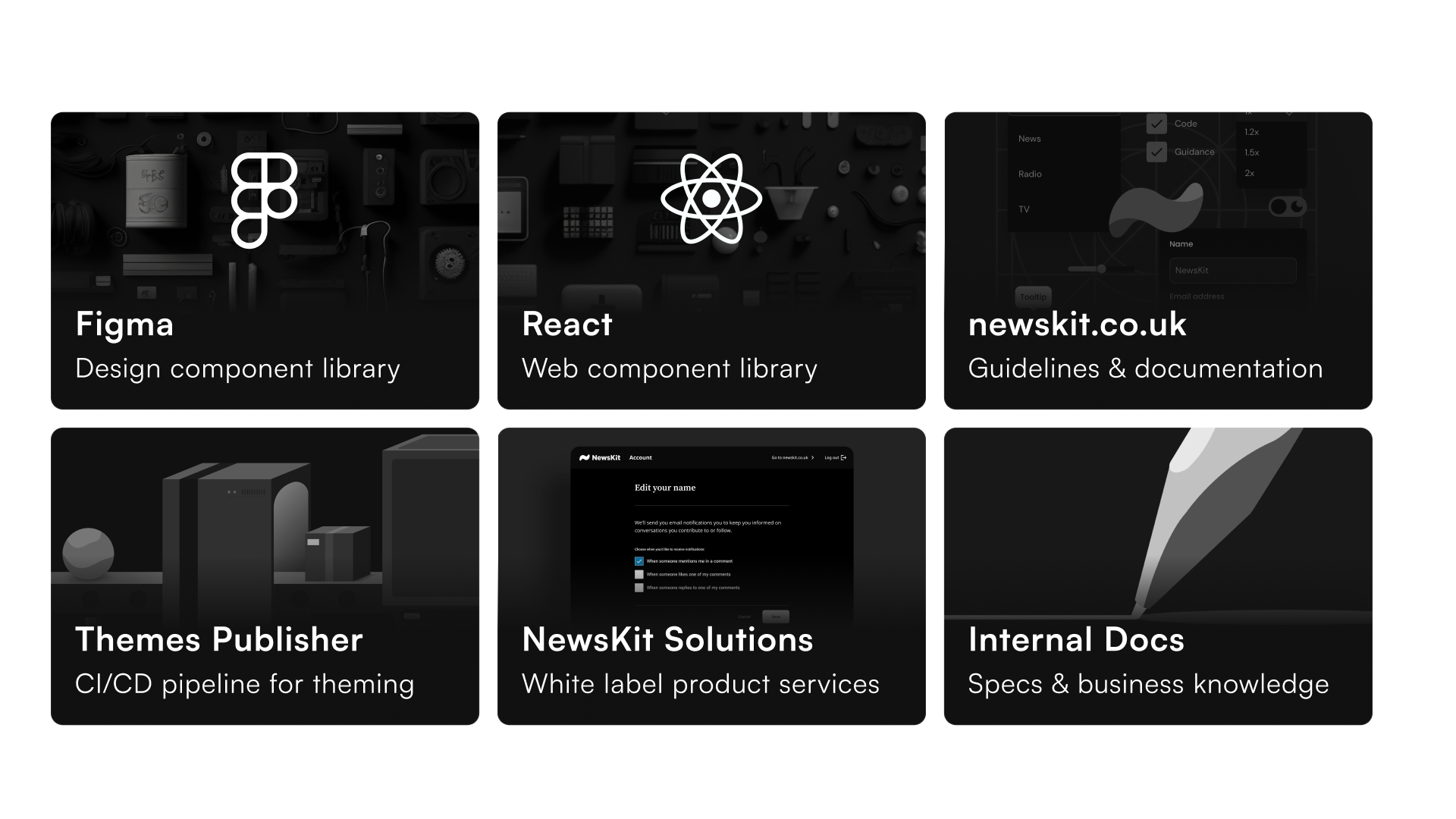
Every team at News uses our Figma component libraries, and we're on the Figma community. We also evolved our themes to support continuous publishing, so a change in Figma goes to GitHub and then to npm, with CI in between.
The React component library was the weak spot.
Why React lagged behind
In the beginning we needed to scale up. We didn't have the component coverage to give a consumer everything they needed, and it took three years to grow the system out.
Along the way, teams picked up components here and there. One team adopted the whole component library and is successfully building its own system on top of it.
But the business units were already established, and some had their own component libraries. They only became more established while we were scaling up NewsKit.
Getting a design system into a product team that's already productive is really hard. It's also often the reason we need a system in the first place. We tend to picture design systems powering green-field projects, but we wanted NewsKit to improve existing monoliths.
Ideal scenarios don't exist
Amy Hupe put the tension well in 2022:
"Contribution to design systems is a socialist ideal ... Capitalism discourages contribution by design"
Systems tend to get dreamed up in ideal scenarios, and the ideal scenario can never exist. That isn't malicious. It's how businesses work.
But design systems are inherently human. Our job is to find common goals and bring people together, and sometimes we meet resistance. The resistance came from three places:
- New things are risky.
- Teams are already productive.
- Our goals are misaligned.
We were trying to solve product problems through the system. Nathan Curtis wrote in 2016 that "A Design System isn't a Project. It's a Product, Serving Products." So we set up a product team of design, product and engineering.
Our first approach
The plan was simple. Gather requirements, build components, ship a system. All the while we were balancing two needs. We needed consumers to prove the system's worth, and we needed to prove its worth to secure consumers.
Nathan's article has a line that says the work shifts "from design and development to managing and marketing a system". It's the second line of the piece. Read past the headline and the point isn't that you stop building. We had to do both.
I wondered if just-in-time delivery would work. Produce exactly what a team wants, and deliver it when they need it.
What the process looked like
Here's how it went, played out with two invented teams, Alex and Bobbi.
Alex asks for a thing that does a thing. We say we can help. But it needs to be accessible, reusable, high quality, consistent and in line with the rest of the system, and it has to be thoroughly documented and useful for everyone. Alex asks how long that will take, because they need it in two weeks. We say at least two months.
Alex says they'll make their own for now and maybe check back in a couple of months.
Meanwhile Bobbi hears about the thing we're building and asks if they can have it. They sort of need something like it, but it does something else. We could change it, but that would take a while. So Bobbi also builds their own and says they'll check in later.
Months later we announce release day. We've shipped a thing that does a thing and something else. And both teams reply that they have their own thing already.
That's a bad result, because we needed people using our components to prove our value.
Advocates, not just consumers
We needed to change how we operate so that we could keep maintaining and marketing the system.
Consumers are how a design system delivers business value. A consumer who uses the system to build consistent, accessible, user-centred products passes the benefits to stakeholders, who get efficiencies, faster time to market, better collaboration and a scalable foundation. Their end users get a consistent product and kick off the feedback loop.
Consumers can also become advocates. I think of advocacy growing in four steps:
- Conscious, where they know the system exists.
- Consuming, where they use it.
- Consulting, where they help improve it.
- Contributing, where they add to it.
Advocates have their own wants and needs, and their main focus is delivering value for their business unit. Multi-tenancy isn't in the interest of the consumer. Consumers act in their own interest and don't care much about the benefits of shared solutions.
So to get buy-in, we have to tailor the pitch to what the consumer needs. We do that the way we approach UX design, by understanding wants, needs and behaviours.
Observe, don't just ask
Our first approach to understanding consumers was the usual one. We looked at their roadmaps, spoke with their designers and engineers, ran clinics and focus groups, and surveyed usage and attitudes.
From experience, what people say isn't always what they do. We needed to see what they were actually doing, and that's what ethnographic studies are for. It's the research tool for understanding real-world use of a product or service, by observing and interacting with the people using it.
My advice is to do the same thing with your design system.
Changing the teams
Within a design system team we're generalists. To the wider business we're the design system specialists. Knowing that, we moved from a centralised design system to a quasi-federated system of satellite teams around a small core.
Everyone took on three roles:
- Generalist in their own skill set.
- Specialist in NewsKit.
- Communicator of product needs and system services.
Members of the centralised team moved into product teams, where they could focus on using the system to deliver business value. That lets us drive growth and understand usage at the same time. Consumer teams now have engineers and designers who know the system, and each team has ownership and autonomy over its own business area. The core team stays to coach people toward the shared goals of the system.
Rethinking our organisational structure also let us rethink how we build the system. The next article is about what that did to our components.